

Lot n° 409
Estimation :
4000 - 6000
EUR
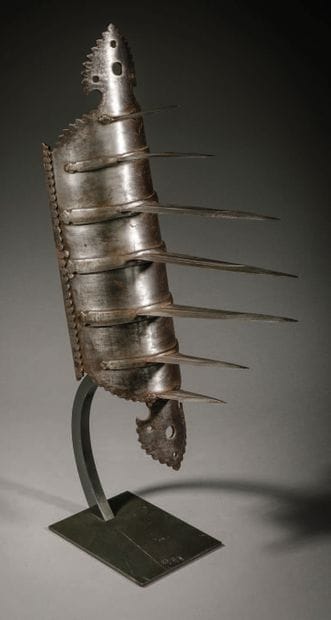
Rare seven-blade weapon - Lot 409
Rare seven-blade weapon
Steel
Northern India, probably Bikaner, late 17th - early 18th century
H. 28 cm - L. 48 cm
This impressive-looking weapon features seven katar blades mounted on the upper part of a tubular element. Underneath, in the center, is a double handle, and on the outer edges of the central part are palmettes with fixing holes. The destination and exact use of this weapon are difficult to determine, but certain features suggest that it was attached to a support. The grip is not satisfactory for good handling, as with a katar with a covering guard or a pata. We can therefore imagine that it was fixed, and that it could be placed on a howdah (elephant palanquin), or even on a battle chariot, the palmettes on the sides and the holes it contains enabling it to be firmly attached to a support.
Two weapons with minimalist decoration used on elephant tusks, dated circa 1600 and also featuring zira boukh (or pierced armor) blades, are preserved in the collections of the English Royal Armory in Leeds (XXVIM.40 A). A small group of similar weapons with three or more blades are preserved in Rajput armories, such as the Junagarh Fort Armory and in Bikaner. Another with three blades is published in ELGOOD, Rajput Arms & Armour, Volume II, Niyogi Books, p. 679.
Although it is impossible to determine its exact use, the most consistent hypothesis is that it was placed on a howdah. Elephants were generally not very effective in combat, but their size and appearance were important in impressing the enemy. Here, we can imagine that the numerous blades placed on the Howdah would have added to the procession's implacable appearance.
My orders
Sale information
Sales conditions
Return to catalogue