

Lot n° 79
Estimation :
12000 - 15000
EUR
DEVADE Marc. - Lot 79
DEVADE Marc.
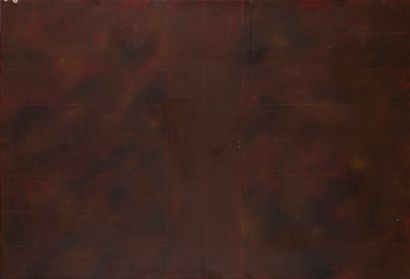
PARADISE N°1. OIL ON CANVAS SIGNED. 1981. 100 x 140 cm
Oil on canvas titled, dated 1981 and signed twice on verso, once on the edge of the canvas, the other on the stretcher.
Slight dents and missing paint lower right.
Provenance :
- Philippe Sollers Collection
A dark blaze
What's it all about? A contemplation without mode, without figure - a breath that can take on the relief of color to let its fire be heard.
Philippe Sollers, Letter to Marc Devade, April 20, 1981
Marc Devade's painting Paradis n°1 arrived at the home of Sollers, the work's dedicatee, in January 1981. Philippe placed it opposite his desk, where his Louis XV secretary, in which he used to write, is enthroned. Le Devade" will only leave this writing lair to join La Deuxième Vie de l'écrivain (Gallimard, 2024), which is now getting underway.
A deep brown cameo, this oil painting reveals subtle golden-copper nuances, chromatic interactions that give relief, or discreetly draw towards orange and purple, when a ray of sunlight brushes against what remains of the fire of this concentrated meditation. Opacity rubs shoulders with a disillusioned transparency that feels like a lack, inviting the eye to linger and be absorbed.
Marc Devade, poet (Poème in Tel Quel no. 18, summer 1964) and philosopher (a student since 1962), broke with the formalism of the Supports/Surfaces movement of the '60s, in which he had started out, and which demanded non-representational painting that turned in on itself to demystify the "mysterious role of the artist". He soon joined the magazine Peinture, cahiers théoriques (1971-1985).
Henceforth, he would seek in painting "a complex act of knowledge", on the boundary between image and language, underpinned by the "will to reflect" to "touch reality with the brush and play it according to [his] desire". The canvases are experienced as the expression of a way of thinking in which "idea is allied to form" and form to idea, to reveal the inner experience of the artist in his "limit states", and also solicit that of the viewer. He converses with cultural memory and concentrates on literature, from which he borrows the titles of his works. He sees his panels as doorways, whose titles are keys that open them to the generation of affect and thought in the intimacy of both artist and viewer.
Sollers writes a poignant preface to the catalog of Devade's last exhibition, at the Galerie des Blancs-
Manteaux in 1981.
Marc Devade, a reader of the pages of Paradis sollersien, didn't name his painting Paradis n° 1 until 1981: his illness had worsened, and the painter recognized himself in the chiaroscuro of this flow of verbal energy without punctuation, which he seized on like a mirror to pay homage to him. Sollers uses the titles of other Devade works, and translates the foreign sources (Italian, English) that also haunt him. He hears and includes words-sounds-thoughts in colors, shapes, pictorial texture; the life of the mind at the limits of the unrepresentable becomes sharable through and in its very strangeness.
Paradis n°1 is no paradise. Two years before his death, Devade revisited the religious tradition by assuming human finitude without melancholy: sovereignly. The cult of paradise is deconstructed in the eye and brush of the artist, who captures "the death of life" (writes Sollers, Paradis II, 1986). He delivers his singular vision of this mortality.
The mortality that constitutes us and that humanity, freed from God, no longer knows how to think about. The "tender melodic consolation" that drives creativity, and which Mozart called "man's best friend".
"You are singularly familiar with death, dear friend [...] you respond with that dark blaze, with those panels where you can hear the fire on the other side. [...] that's why your work is not 'abstract'" (Sollers, letter to Devade).
Don't the golden hues of Paradis n° 1 foreshadow the soil of the caveau, the ultimate, sepulchral ground, absolute rest? If there is no Beyond, let's open the Requiem to the "gates" of sense and sensibility. Is this not another Paradise? Dark blaze. Death is a category of being and not of nothingness (...) death is what naturally happens to being outside its point of infinite enjoyment (Philippe Sollers, Paradis II, 1986).
My orders
Sale information
Sales conditions
Return to catalogue