

Lot n° 15
Estimation :
40000 - 60000
EUR
Result with fees
Result
: 50 113EUR
Carved limestone Virgin and Child nursing. Seated on a thron - Lot 15
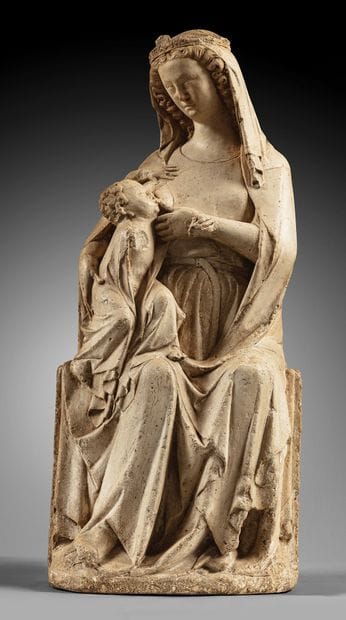
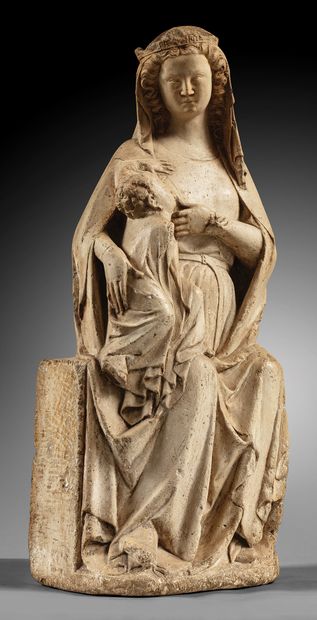
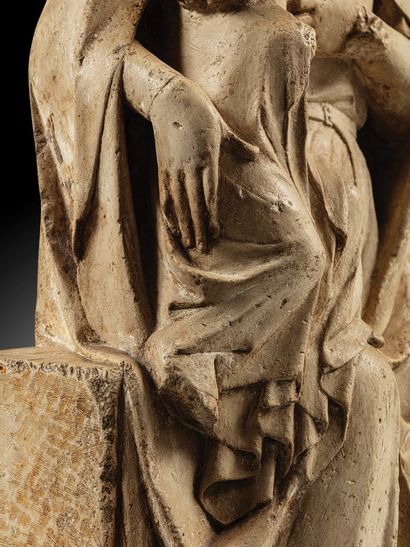
Carved limestone Virgin and Child nursing. Seated on a throne-bench, Mary offers her womb to her Son, dressed in a long tunic, who is standing on her right knee. Her head is crowned, and she wears a dress with a simple neckline, belted at the waist, as well as an open cloak, the flaps of which fall to the front of her knees.
Normandy, second quarter of 14th century
H. 81 cm - W. 34 cm - D. 21 cm
(Child's right arm missing, slight accidents)
Provenance
- Collection Lepel-Cointet, Abbaye Notre-Dame de Jumièges (Seine-Maritime), between 1853 and 1921.
- Collection L. Salavin - Sale Paris, Hôtel Drouot, Mes Ader-Picard-Tajan, November 22, 1972, Expert Ratton, lot 70.
- Sale Paris, Hôtel Drouot, Mes Ader-Picard-Tajan, December 19, 1973, Expert Ratton, lot 111.
This sculpture exudes a singular harmony, not only in the arrangement of its drapery, but also in the expression of maternal tenderness that it conveys with elegance, sensitivity and delicacy: Mary guiding the nipple into the mouth of the Child with her thumb, who expresses her possessive contentment through the positions of her hands, one placed on her Mother's shoulder, the other grasping her wrist. Few medieval Virgins show such humanity, the most illustrious example being the silver portrait of Jeanne d'Évreux, produced between 1324 and 1339, considered one of the first Virgins of tenderness. With her broad face, outstretched eyes and thin lips, framed by a remarkable head of hair with strong waves, this nursing Virgin is a perfect example of the French Gothic style.
Founded in the 7th century, the Abbey of Notre-Dame de Jumièges embodies the apogee of Norman monasticism in the Seine valley, of which it is the largest and oldest of the great abbeys. Devastated by Viking raids in the 9th century, it was first reborn in the 11th century, then experienced a second flowering in the 13th century, which marked the golden age of its history and, in particular, of its renowned scriptorium.
Like many other French abbeys, Jumièges gradually fell into decline from the 16th century onwards, a victim of the commendation system and the Wars of Religion; its last monks had to leave the site during the Revolution. In 1853, the ruins of the partially destroyed abbey were purchased by the Lepel-Cointet family, who opened a museum housing the furniture and lapidary that had not been dispersed in 1791. In 1921, this sculpture was housed in the museum and photographed by Henri Heuzé (1851-1927), as attested by the French Ministry of Culture's Heritage database.
Book consulted:
- L. Lefrançois-Pillion, "Les statues de la Vierge à l'Enfant dans la sculpture française au XIVe siècle" in Gazette des beaux-arts, 1935, II, p. 205, fig. 2 (private collection). "Nowhere has [the mantle] been used more skilfully than in the Seated Virgin (fig.2), where its two parallel strips envelop the bust in such a harmonious line."
My orders
Sale information
Sales conditions
Return to catalogue