

Lot n° 40
Estimation :
20000 - 30000
EUR
Martin-Claude MONOT (1733-1803) - Lot 40
Martin-Claude MONOT (1733-1803)
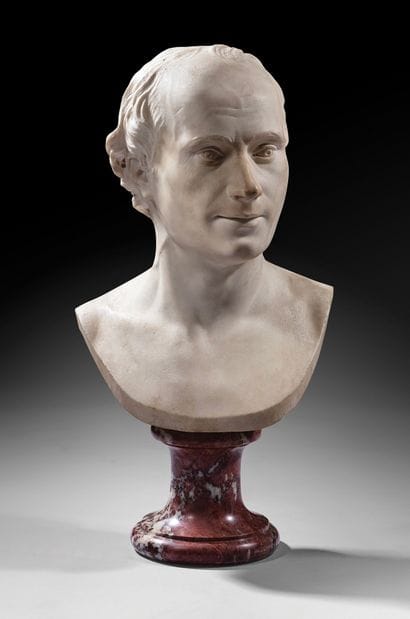
Guy Jean-Baptiste Target, avocat au parlement (1733-1807)
White marble bust, signed and dated "Monot 1769".
H. 41.5 cm - L. 30.5 cm
Exhibition:
- Paris, Salon de 1769, catalog no. 232
Bibliography:
- Explication des peintures, sculptures, gravures de messieurs de l'Académie royale, Paris, imprimerie Hérissant, 1769
- Stanislas Lami, Dictionnaire des sculpteurs de l'école française au dix-huitième siècle, tome II, Paris, ed Champion, 1911, ed. Republished 1970, t. II, 4, p.171.
Pupil of Louis-Claude Vassé, winner of the first prize for sculpture in 1760, boarder in Rome and then accepted by the Académie royale in 1769, Martin-Claude Monot belonged to this generation of artists who were moving portraiture towards a neoclassical naturalism in search of psychological truth. Produced in the year of his approval and exhibited at the Salon of the same year, 1769, this marble bust represents the lawyer Guy Jean-Baptiste Target at the age of thirty-six. This period corresponds to the ascension of the lawyer's career, when he intervened in the Jesuit and Calas family cases, and before becoming one of the legal voices of the Revolution, deputy to the Estates-General, signatory of the Jeu de Paume oath and architect of the Napoleonic Code.
Monot depicts the man of the law "au naturel", without wig or costume. The head is bare, the torso undressed, in a highly modern simplicity that foreshadows the portraits of Diderot by Houdon (1771, Paris, Musée du Louvre, no. RF348) or Voltaire by Pigalle (Voltaire nu, 1776, Paris, Musée du Louvre, no. ENT 1962.01). The hair, finely streaked with gradine, contrasts with the polished softness of the epidermis, and the slight twist of the bust. Combined with the distant gaze, it lends the model an inner presence, somewhere between intellectual vigilance and meditation. A critic at the Salon, Diderot complimented this work even though he had little appreciation of the sculptor's talent: "The portrait of the lawyer Target, where recognition has supplanted talent. I like the fact that the heart has done what talent alone could not". The author emphasizes the sincerity of this portrait of friendship, which exudes a real, intelligent presence. The portrait stands out from other later effigies of Target, fixing the features of the young lawyer destined for an illustrious career. It is likely that this bust served as the model for the profile medallion that adorns his tomb in the Père-Lachaise cemetery, erected in 1833.
My orders
Sale information
Sales conditions
Return to catalogue