

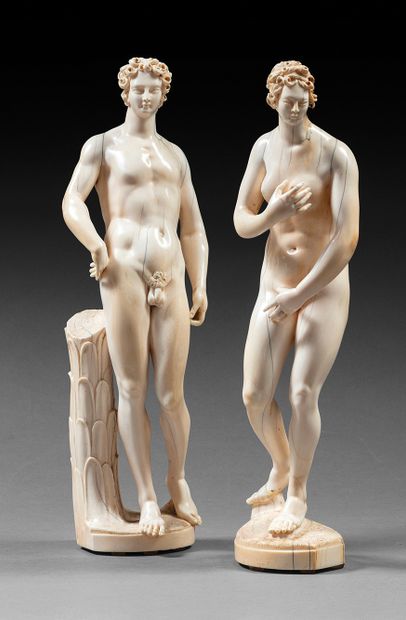
Lot n° 84
Estimation :
15000 - 20000
EUR
*Germany or Italy probably from the second half of the 18th - Lot 84
*Germany or Italy probably from the second half of the 18th century after the antique
Pudique Venus and Antinous of Belvedere (now called Hermes of Belvedere)
Two ivory statuettes
H. 41 and 42 cm
(Restorations to Venus' ankle and foot, insert of a period piece in Antinous' head)
Provenance :
- Parisian collection, an apartment decorated by Alberto Pinto
Related literature:
- Francis Haskell, Taste and the Antique - The Lure of Classical Sculpture 1500-1900, New Haven and London, Yale University Press, 1981, no. 88, pp. 141- 43 and 325-28, figs. 5 and 173; -Ss dir. Heike Schmidt and Maria Sframeli, Diafane Passioni Avori barocchi dalle corti europee, Livorno, Firenze Musei, Sillabe, 2013 ;
- Karin Annette Möller, Elfenbein Kunstwerke des Barock, Staatliches Museum Schwerin, Catalogue of the exhibition held from March 31 to June 04, 2001, Schwerin, Staatlichen Museum, 2001.
Reference works :
- Late 2nd sec. A.C. - Early 1st sec. A.C. Medici Venus, marble, 153 cm, Florence, Uffizi Palace, n°inv. A16. Tribuna
- Hadrian period, Hermes of Belvedere, previously known as Antinous of Belvedere, white marble, 195 cm, Rome, Vatican Museum, n°inv.907
This pair of imposing ivory statuettes is inspired by the most famous works of ancient art, the Antinous of Belvedere and the Medici Venus.
The former, housed in the Vatican Museums in Rome, was first recorded in 1543. Today, it is considered a representation of Hermes in his role as psychopomp. The second is listed in Cardinal Ferdinand de' Medici's inventory of 1584, before being transported to Florence in 1675, where it has since taken pride of place in the Tribune of the Uffizi Gallery. These two sculptures have been among the most admired antiques in Rome since their discovery, and were widely disseminated throughout Europe in the following centuries in the form of drawings and prints, casts, bronzes or small statuettes in ivory or wood, such as the one created by Johannes Sporer (ca. 1720- 1759) preserved in Florence at the Museo di Casa Martelli (inv. Martelli n.130).
Our two figures could have been executed in the second half of the 18th century in Italy, in Rome or Florence, major centers of ivory sculpture production at the time. Italian workshops produced reductions of great antique models to satisfy an international clientele, especially Grand Tour visitors fond of classical culture. However, these works may also have been executed by a German workshop, such as those in Dresden or Düsseldorf, which also produced numerous antique-inspired reductions for princely collections and the cultivated bourgeoisie in the 18th century. Here, the subjects have been simplified compared to the original models: Venus is shown standing without her dolphin, and Antinous leaning against a tree trunk without his drapery, both in their simplest garb. By stripping them of their attributes and using a very smooth polished finish, the sculptor has emphasized the nudity of the figures. Paired in this way, Venus and Antinous represent the masculine and feminine ideals of classical beauty. However, the treatment of the hair and the morphotype of the faces testify to the anonymous artist's desire to distance himself from the classical canons by marking his works with a more personal style, making this pair of statuettes unique collector's items while at the same time conveying the universal character of the classical ideal of beauty.
CIC dated June 23, 2025
My orders
Sale information
Sales conditions
Return to catalogue