

Lot n° 31
Estimation :
40000 - 60000
EUR
Important salon furniture in molded and carved walnut, consi - Lot 31
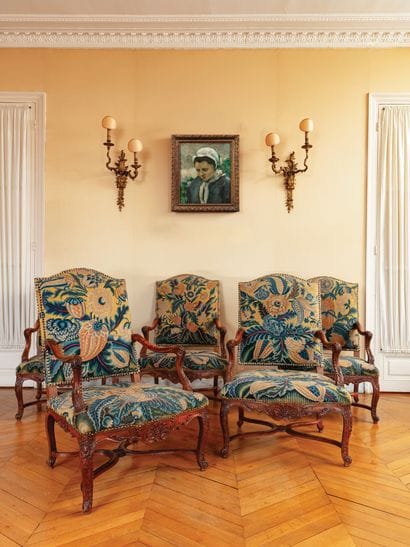
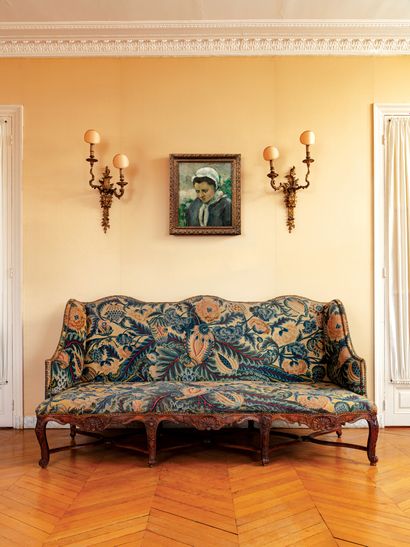
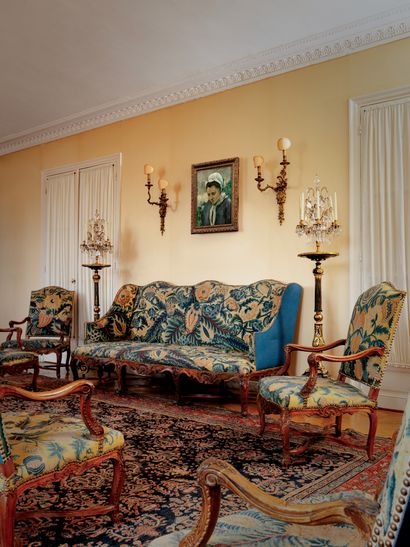
Important salon furniture in molded and carved walnut, consisting of a sofa and eight high flat-back armchairs; the arm brackets are curved with foliage; the front crosspieces with shells stand out against squared backgrounds; they rest on cambered floret legs ending in scrolls joined by a brace centered on a rosette.
Regency period
Tapestry upholstery with large foliage and poppy blossom motifs from the same period.
Sofa : H. 110 cm - W. 214 cm - D. 98 cm
Armchairs: H. 104 cm - W. 73 cm - D. 78 cm
The end of Louis XIV's reign and the new Regency period saw an exceptional renewal of motifs and forms in the French decorative arts. In the particular field of chair carpentry, creation remained dominated by Etiquette, which imposed a protocol-like importance on the use of chairs. Thus, at the time of Louis XIV, only the King and Queen were allowed to sit on armchairs at Court, while princes of the blood had back chairs and duchesses stools, and other members of the Court were invited to stand facing the sovereign. More broadly, in French society in the first decades of the 18th century, the various models of chair retained a certain solemnity, but were appreciated above all for their large proportions, the quality of their carved decoration and the luxury of their upholstery. At this time, upholsterers used the most sought-after and richest fabrics; leather was now out of fashion, but velvets from Genoa or Venice, brocade, damask, lampas and tapestry au point were the most appreciated by the great connoisseurs of the time. The general composition of the woodwork preserves a noble architecture, characterized by a high, flat back separated from the seat by short, sculpted uprights; armrests that draw flexuous movements animated by convex and concave lines; and finally, legs, often worked into balusters or treated as consoles, sometimes joined by braces, which adopt a cambered design under the Regency.
The important salon furniture on display here, comprising a triple-evolution sofa and eight large flat-back armchairs, was created in this particular context. It bears all the hallmarks of the best Parisian furniture of the late 1710s and the early 1710s, revealing the many influences of two styles tending towards the development of a new decorative aesthetic in the decades to come. Indeed, while the presence of certain details and motifs is still strongly marked by the art of carpenters at the end of Louis XIV's reign, particularly in the treatment of the fully upholstered straight-backed uprights, the general composition of the seats is enlivened, the armrests take on an agitated form, the legs arch and the whole is elegantly and richly embellished with stylized shell and acanthus motifs sculpted with great skill.
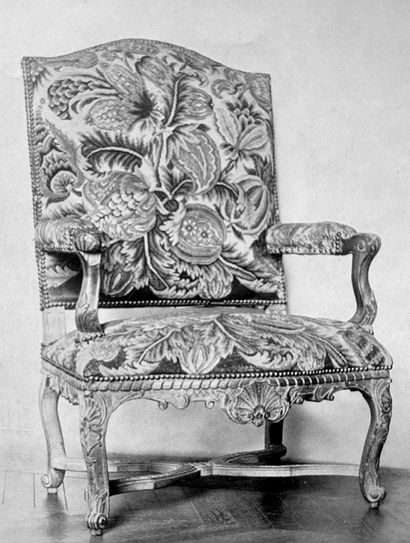
All these features are signs of a new taste that can be found on other similarly designed chairs from the same period, such as a carved and gilded wooden armchair in the Musée des Arts Décoratifs in Paris (see R. Verdier, Le style Régence, no date, p.92-93) (Fig.); and a model formerly in the Hoentschel collection, illustrated in an interior view in N. Hoentschel, Georges Hoentschel, Editions Monelle Hayot, 1999, p.215; see also a piece of salon furniture reproduced in C. Demetrescu, Le style
Régence, Les éditions de l'Amateur, Paris, 2003, p.69, fig.44; last but not least, an armchair in the collections of the Musée des Arts décoratifs in Paris (published in S. de Ricci, Louis XIV und Régence, Raumkunst und Mobiliar, Stuttgart, 1929, p.96).
My orders
Sale information
Sales conditions
Return to catalogue